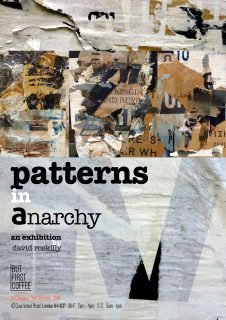
A second meeting. This time at North London’s Boulangerie Bon Matin where David had his ‘Intertexuality’ exhibition – showing many of the collages that are archived on this site.
On influences; Jamie Reid and David Carson.
Towards the end of our last meeting we discussed influences; you mentioned Patrick Heron, Jamie Reid and David Carson. I think everyone knows the work Jamie Reid did with Malcolm McLaren for Sex Pistols.
“He was a friend of McLaren and therefore Vivienne Westwood. Apparently it was Reid who suggested to Westwood she should try tartan. And Jamie Reid was instrumental in a lot of McLaren’s ideas; they went to college together.”
Where were you when you first saw Jamie Reid’s work?
“I was at art college and I was always interested in collage. I was always in the library. There was no internet then but St Martins had a superb library and it was right in the middle of Soho. There were all these Richard Hamilton exhibitions going on down the road in Cork Street and Jamie Reid’s stuff was breaking. And it wasn’t just visual art; it was fashion as well you started to see. And I was impressed by the DIY fanzines that were xeroxed, accessible.”
All pre-computer.
“At that time I was working in the West End in a dark-room, in a photographic place. And before computers and software like Quark you used to do things on process cameras (PMT). Clients would say ‘We want this piece of text at 9 point’ or whatever so you would make a print, cut it out, cow-gum it down and make a piece of artwork and that’s how you set type. And I would take all the mistakes and surplus stuff out of the bin, take it home and collage with it.”
Do you still have that work?
“No. Just after 2000 I took all my work down to Cornwall, down to the beach, dug a pit at night and burned it. It was a bit toxic and I burned it all.”
Do you feel better for doing that?
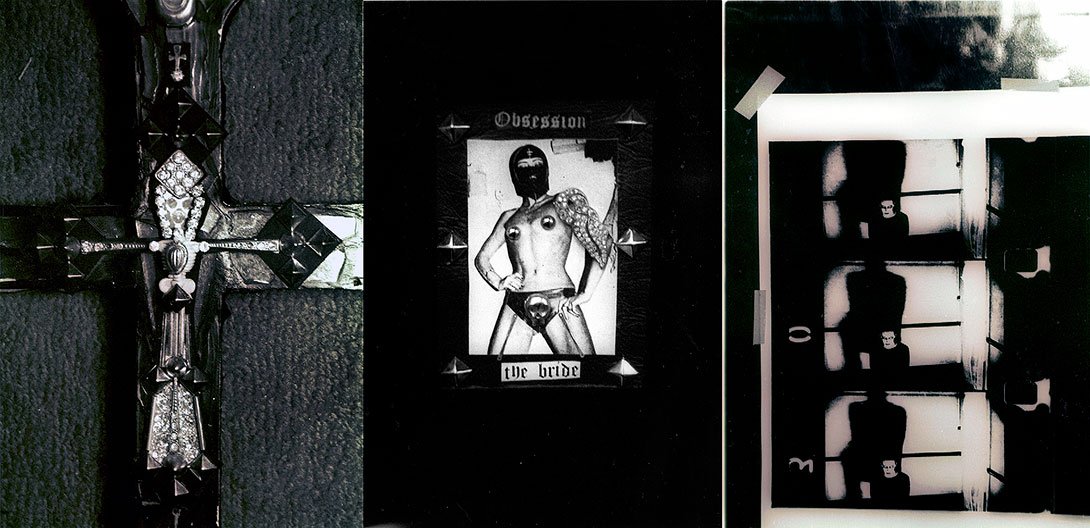
“Not now. Because some of it was lovely work. I was collaging with studs. Like the studs in leather jackets. And seeds. And sea-shells. And mixed up with stuff from bondage magazines. It was wild. But I burned it all.”
And David Carson was a big influence?
“I first saw his work in Bikini and Raygun magazines. He never had a design training. He was a sociology teacher and a professional surfer. He would do the same as Jamie Reid. He was xeroxing and cutting-up. And he broke all the rules because he said ‘I don’t know the rules’. People said to him that you need to know the rules to break then and he said ‘rubbish’. He said it was to do with intuition.
Intuition?
“Yes. You take a piece of graphic design – you have a grid and you ‘snap’ to the guides. He said turn off snap to guides. Never snap to guides. Never let a computer tell you where something should be. He asked ‘who says columns should be an equal width?’ ‘Who says they should be square?’ Some of his stuff is sloping. He said we all key in, principally on visual things. So if you want to get someone to read something, get them interested visually. Entice them in. His big thing was to say ‘never mistake legibility for communication’.”
And he is a big influence?
“Absolutely. He would say never put something where you think it should go – at least to begin with. Never just put it where you think it should go, work with it. Move it around. Follow your intuition. Which is what I do when I make my collages when it comes to shape, texture and colour. They take on lives of their own.”
It looks painstaking. But its not painful? There is fine detail in your collages – very small pieces beautifully cut and pasted. That looks like exacting, precise work.
“When I used to make art it was painful, tortured artist and all that stuff. But there’s no pain in this. Because this is authentic. There is frustration. There’s agony sometimes but its only temporary.”
What’s the agony?
“When its not working. I go to bed at night knowing its not working. It really bothers me and I can’t sleep. But I get up in the morning and its still there and it gives me different feedback in the morning.”
Do you use glue to stick all the pieces together?
“Acid free PVA. The beautiful time is when I’ve got them all spread out under heavy glass and I can lift the glass and move the pieces around. Then I replace the glass and the glass presses them down. The painful time is when I have to glue them up. I have to tape them and hinge them – hinge every individual piece with tape. It might take about 4 hours to hinge and tape one medium sized collage.”
And the titles?
“Some were obvious. ‘Skin’ reminds me of skin. ‘Relic’ looks like it was dug out of some old temple. There are others I have no idea what to call them. But I remembered what Kurt Schwitters did. He used to take his titles from pieces of text that he found in his collages. So I have one called ‘3001 Hennessey Black’ because I found that text when I finished, when I looked into it to read it.”
The collages are full of trapdoors and windows. They are full of other peoples lines, photographs, words. They don’t seem to impose one clear message – you are very free to wander when you look at them.
“Thats the power of collage; I’ve only done part of the work. Some other person made up an artwork. I don’t always know where it came from; there is a bit of a screen-print or a bit of something made with stencils. I would spend a few days on each of them but there’s already weeks of other people’s work present.”
I like the way the collages shift with the changing light; there are some gold elements that catch and reflect the light. Its not gold leaf but it has that effect.
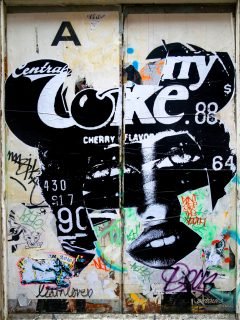
“Its nice working with streetart – obviously they use a lot of metallic spray paint and it means they shift if you put them up on the wall; they shift with the light.”
Evolution of a Poster
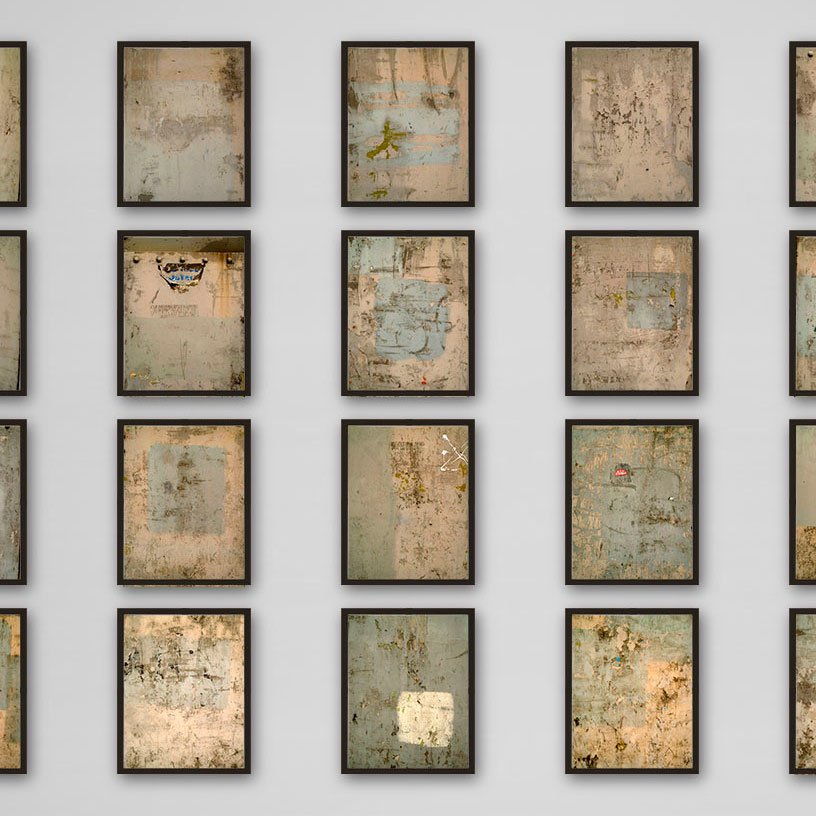
You created a series of photographs under the tile ‘The Natural Evolution of a Poster’ – each collage features elements from the same, source image – an aeroplane dropping bombs (the original poster was produced by VOLKS Gallery, Nicosia). I assume they aren’t all taken from just one bit of wall – did you see the same poster at different locations?
“Yes.”
In one of the photographs the poster has been cut away leaving just the bombs. Did you do that? Did you cut away the background to isolate the falling bombs?
“No.”
It happened naturally?
“Yes. The weather gets it. I was responsible for some of it. But it wasn’t intentional. I was ripping off what I could. I’ve got some of those bombs and they’re in some of my canvases.”
I really thought someone had deliberately cut away the white background to leave the black bombs.
“I think it was quite natural. I don’t think anyone else pays attention. But that’s the thing. There’s a hidden agency behind the intertexuality.”
A hidden agency?
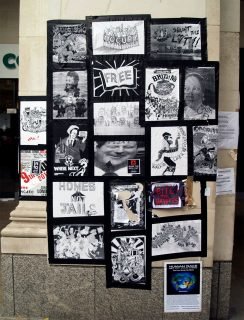
“No one edited that poster. The weather did it. Nature is communicating with us. I’m doing a whole series called ‘analog’. Its to do with the intertexuality of nature that is in our environment – the continuing communication, the continuing message. The reason I keep talking about Exarchia in Athens is that its a good mixture; you get street art, advertising, you get political stuff and its always being posted on top of – and people are spraying on top of it.”
But you suggest the walls of Exarchia reveal the pattern of some underlying agency?
“Nature is the message you see when you stare at a palm tree and the fronds are moving in the wind. Its a pattern. Its an analog pattern. Its random. There’s another communication. Thats all.”
And the work on the walls?
“Also exposed to the influence of nature. And man”
Punk as Collage: Collage is Punk
We were talking about Jamie Reid earlier; I guess the image he created of the Queen with a safety pin through her nose is super iconic.
“From a UK-centric perspective the safety-pin through the Queen’s nose is pretty much on a level with the Malevich square.”
But you must have seen collage before Reid; why was he such an influence?
“He set collage free again. I was aware of what was done before. I was aware of Schwitters, Dada, Surrealism and Cornell. But they all existed in art books. And this stuff (Reid) existed up the road in the Virgin megastore or on a record. I remember queuing outside HMV in Oxford Street the day ‘Anarchy’ (Sex Pistols’ ‘Anarchy in the UK’) came out and I bought a copy of it. He brought it into an immediate context.”
You also mentioned Richard Hamilton?
“I could go down the road to Cork Street in my lunch hour and see Richard Hamilton’s work. But when Jamie Reid’s stuff came along I didn’t have to go to an art gallery to see his work. I just had to go out onto the street. I even saw people wearing it; I saw people walking around with safety-pins. I came to London from Cornwall; I remember arriving in Finsbury Park and you know the long tunnel in the station? I was walking up the tunnel and this guy and girl were walking down the tunnel and she had a dog-collar around her neck and he had her on a lead. This was 1976.”
London was very different from Cornwall…
“Where I come from is near St Ives. In St Ives in the 60s there was a thing going on with the beatniks. There was a huge outcry in St Ives because the town was invaded by beatniks every summer. I remember being with my mum in the main street and there was this guy in bare feet and he’s got jeans on and he’s cut the jeans, he’s slashed them… and everybody stopped to look. Everybody stopped talking. I remember we were were outside a tailor’s shop and the tailor came out with the tape measure around his neck and he was stunned. And this guy just had some ripped jeans!”
But the punk fashion is like collage?
“Its all tied up with the relationship between Jamie Reid and Malcolm McLaren and therefore McLaren and Westwood. People used to attach images with safety pins to clothing. Its collage. As far as I was concerned what people were wearing was collage. We collage every day.”
And can you define collage?
“Its taking pieces of material and bringing them into one space and juxtaposing them.”
Back to the 90s: on early Web and his own Web art
When I went to Malcolm Garrett’s website to have a look at his website design I found many of the links to sites he designed are broken. The work has vanished! I remember you said the work you did for the Strongroom had gone…
“I’ve still got it. I was really proud of it. It was early 90s and nothing like that had been done before. It had an interface with a menu at the bottom and a menu at the top and it was curved like a console with two square split-screens and the content on the screens changed independently of each other – which I took from Andy Warhol when he used to project 2 different films side by side.”
And did you put any strange things on-line or author any odd sites?
“Yes. I did a few. And I did put up one piece of web-art, using the medium. There was some interesting stuff using the web as medium, like Jodi.org.”
I like that. I’ve seen that.
“Did you know there’s hidden stuff in that? You have to look into the source code.”
How do you do that?
“You bring up the source code. It helps to be a coder. There are hidden links inside the source code that you have to take, type, copy and paste and that will take you off into hidden stuff. And I was doing stuff like that.”
For example?
“I hid a whole site. I did a site called ‘403 forbidden’. You know how you get an Apache Server Message that comes up and says ‘403 Forbidden’? That was the front page. I took the Apache Error page and recreated it exactly as it looked so when it came up perhaps people wouldn’t go further but if you read carefully the message says something more interesting. It says ‘server can’t find the specified URL and this is generated by Apache Server etc. but right at the very end and not coloured as a link it says ‘but are you going to let that stop you?’ And that was the link into the site.
What was the site?
“Web art.”
Did anyone click and enter?
“No one ever did. No one ever reads an error message.”
© Tony Marcus 2019





Comments?